
Introduction
Both tools promise to hide your online activity, but they do not work the same way at all. Understanding VPN vs proxy differences can help you pick the right tool instead of guessing based on marketing claims. In this article, we will break down how each one works, where the real gaps in protection show up, and which situations call for one over the other.
People often use these two terms as if they mean the same thing, partly because both tools change how your connection looks to the outside world. Once you see what happens behind the scenes, though, the differences become obvious, and so does the right choice for your situation.
Why This Comparison Confuses So Many People
Both a VPN and a proxy sit between your device and the websites you visit. That similarity is where most of the confusion starts.
Both tools also change your visible IP address, which is the main thing most people care about at a glance. Since that outcome looks identical on the surface, many people assume the tools underneath must work the same way too.
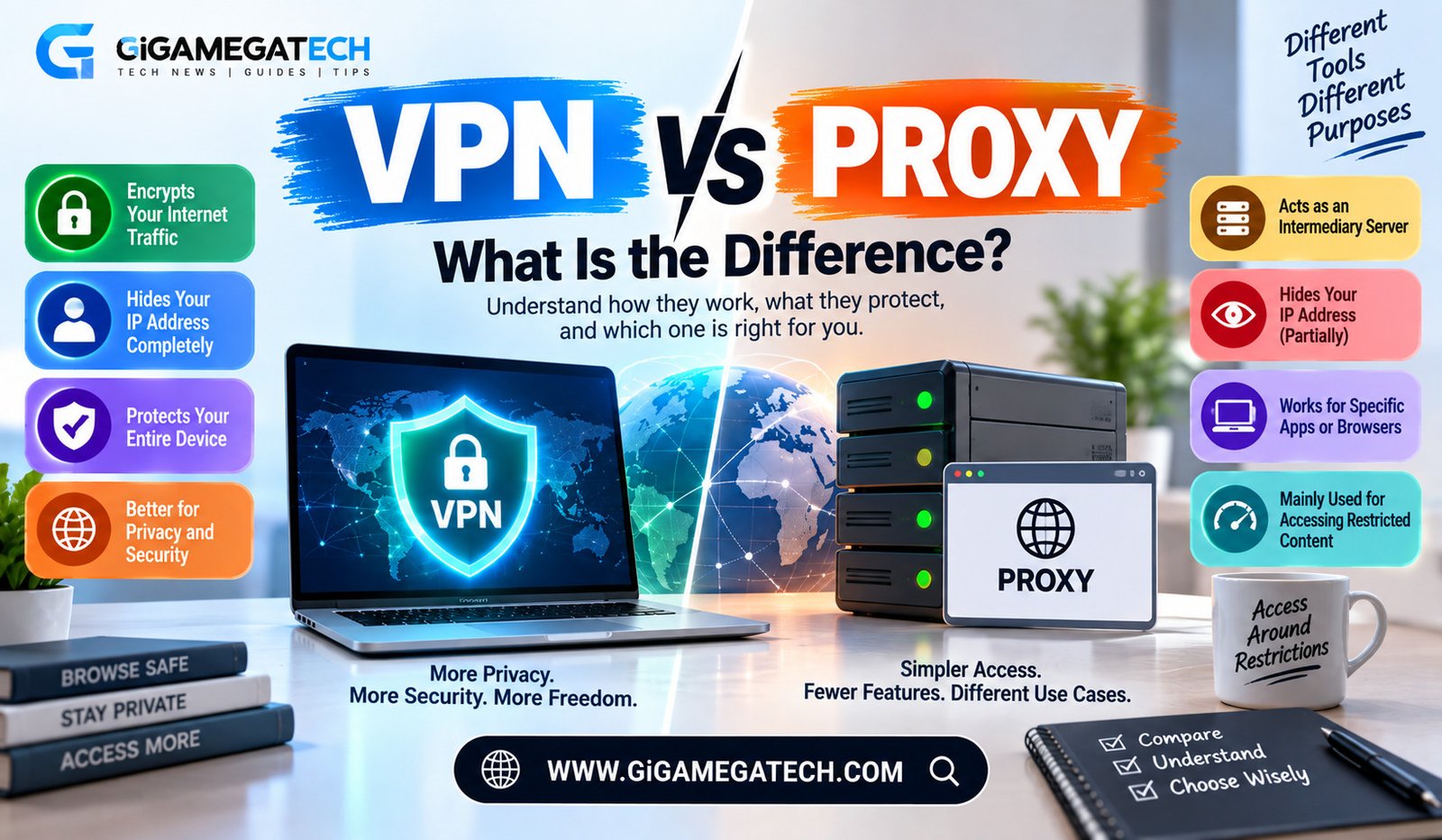
The real difference comes down to how much protection each one actually provides, and at what level of your connection it operates. A VPN changes things at the system level, while a proxy usually changes things at the app level. That distinction sounds small, but it shapes everything else about how each tool performs.
Once you see how each one handles your traffic, from encryption to device coverage, the choice between them becomes much clearer. The rest of this guide walks through exactly where those differences show up in practice.
How a VPN Works
A VPN, short for virtual private network, creates an encrypted tunnel between your device and the internet. Instead of your data traveling in a form that anyone monitoring the network could potentially read, it travels scrambled until it reaches the VPN provider’s server.
Encrypting Your Entire Connection
Every app and service on your device sends its traffic through this tunnel once a VPN is active. This includes browsers, email clients, background apps, and any other service quietly sending or receiving data. Nothing on the device bypasses the tunnel unless you specifically configure it to do so.
Hiding Your Real Location
Websites you visit see the VPN server’s location instead of your actual one, which helps mask your real identity online. If you connect to a server in another country, sites and services will generally treat your connection as if it originated there.
Why This Matters in Practice
This full-device coverage is why a VPN is often considered the stronger privacy option between the two. A single toggle protects everything running on your phone or computer, rather than requiring you to configure each app individually. For most people, that convenience alone makes a meaningful difference in how consistently their traffic actually stays protected.
How a Proxy Works
A proxy server also reroutes your traffic, but in a more limited way than a VPN. Instead of wrapping your entire device in a protected tunnel, a proxy typically works with a single application at a time.
Here is what typically happens with a proxy:
- Only the traffic from a specific app or browser is redirected
- The connection is often not encrypted, unlike most VPN traffic
- Your visible IP address changes, but other data may still be exposed
- Setup usually applies to a single app rather than the whole device
Because a proxy only reroutes traffic from whichever app you configure it for, everything else on your device continues to connect normally, without any added protection. This narrower scope makes a proxy simpler to set up, since there is less to configure overall, but it also means less overall protection compared to a full VPN tunnel.
Some proxies specialize in specific tasks, such as retrieving region-locked content or masking a browser’s location for a single session. That narrow focus can be an advantage when you only need a quick, temporary change rather than an always-on protective layer.
VPN vs Proxy for Privacy and Security
When it comes to actual privacy, the two tools are not equally matched. The gap becomes especially clear once you look closely at encryption and device coverage side by side.
Encryption Differences
A VPN generally encrypts data end to end, protecting it from being intercepted on public networks like airport or coffee shop Wi-Fi. Many proxies skip encryption entirely, which means your data can still be visible to anyone monitoring the same network, even though your IP address looks different.
Coverage Differences
A VPN protects every app running on your device, while a proxy usually protects just one, such as a web browser. If you use a messaging app, a cloud storage service, or any other background process, a proxy set up only for your browser will not extend any protection to those other apps at all.
Why This Gap Matters
For anyone using public Wi-Fi regularly, this encryption gap makes a real difference in overall safety. A proxy might disguise where your browser traffic appears to come from, but it does little to protect the actual content of that traffic from being intercepted. A VPN closes both gaps at once, which is why security-focused use cases lean so heavily toward VPNs rather than proxies.
VPN vs Proxy for Everyday Use Cases
Choosing between the two often comes down to what you are actually trying to do, rather than which tool sounds more advanced or secure in the abstract.
When a Proxy Makes Sense
A proxy can work well for simple tasks like accessing region-specific content in a browser, where full-device encryption is not necessary. If you just need to check how a website appears from another country, or bypass a basic content restriction for a single browsing session, a proxy handles that without much setup.
When a VPN Makes Sense
A VPN suits situations where privacy and security matter more broadly, such as working remotely, using public networks, or protecting sensitive data across multiple apps. Remote workers handling company files, travelers connecting to unfamiliar Wi-Fi networks, and anyone concerned about broader online tracking all benefit more from a VPN’s full-device coverage.
Matching the tool to the actual task avoids paying for more protection than you need, or settling for less than you should have. Someone who only occasionally needs to view region-locked content does not necessarily need a full VPN subscription, while someone handling sensitive information daily should not rely on a proxy alone.
Cost and Setup Differences
Beyond privacy and security, cost and ease of setup often factor heavily into which option people actually choose.
Proxy Costs and Setup
Free proxies are widely available, and setup often involves entering a server address directly into a browser’s settings. This low barrier to entry makes proxies appealing for quick, one-off tasks, though free options can come with slower speeds or inconsistent reliability.
VPN Costs and Setup
Most reputable VPN providers charge a subscription fee, though free tiers exist with more limited features. Setup typically involves installing an app rather than adjusting individual browser settings, and the app then manages the encrypted tunnel automatically in the background.
The extra cost of a VPN generally reflects the added infrastructure needed to encrypt and route all of your device’s traffic reliably, rather than just a single app’s connection.
Which One Should You Choose?
The right choice ultimately depends on how much protection your situation actually requires, not on which tool has the more impressive reputation.
If you need full-device protection, encrypted traffic, and consistent privacy across every app, a VPN is the more appropriate choice. If your needs are limited to a specific browser task, and encryption is not a priority, a proxy may cover what you need at a lower cost or with less setup involved.
Key Takeaways
- Main difference: A VPN encrypts and reroutes your whole device, while a proxy usually covers a single app.
- Stronger privacy option: A VPN, due to full encryption.
- Simpler setup option: A proxy, since it often applies to just one app.
- Best for public Wi-Fi: A VPN, because of its encrypted connection.
- Best for simple browser tasks: A proxy, when encryption is not a priority.
- Cost consideration: Proxies are often free, while most reliable VPNs charge a subscription.
FAQs
Is a VPN always safer than a proxy? A VPN is generally safer due to full-device encryption, though the exact safety also depends on the specific service used.
Do proxies hide my IP address completely? Proxies do hide your visible IP address, but other identifying data may still be exposed without encryption.
Can I use a VPN and a proxy at the same time? Yes, though using both together is usually unnecessary for most everyday privacy needs.
Are free VPNs as safe as paid ones? Free VPNs vary widely in quality, and some may collect more data than paid alternatives.
Which option is better for streaming content from another region? A proxy can work for simple browser-based streaming, though a VPN often provides more reliable and secure access.
Conclusion
The VPN vs proxy decision comes down to how much protection you actually need. A VPN covers your whole device with strong encryption, while a proxy offers a simpler, narrower solution for specific tasks. Knowing this difference, along with the cost and setup tradeoffs involved, makes it much easier to choose the right tool for your situation.