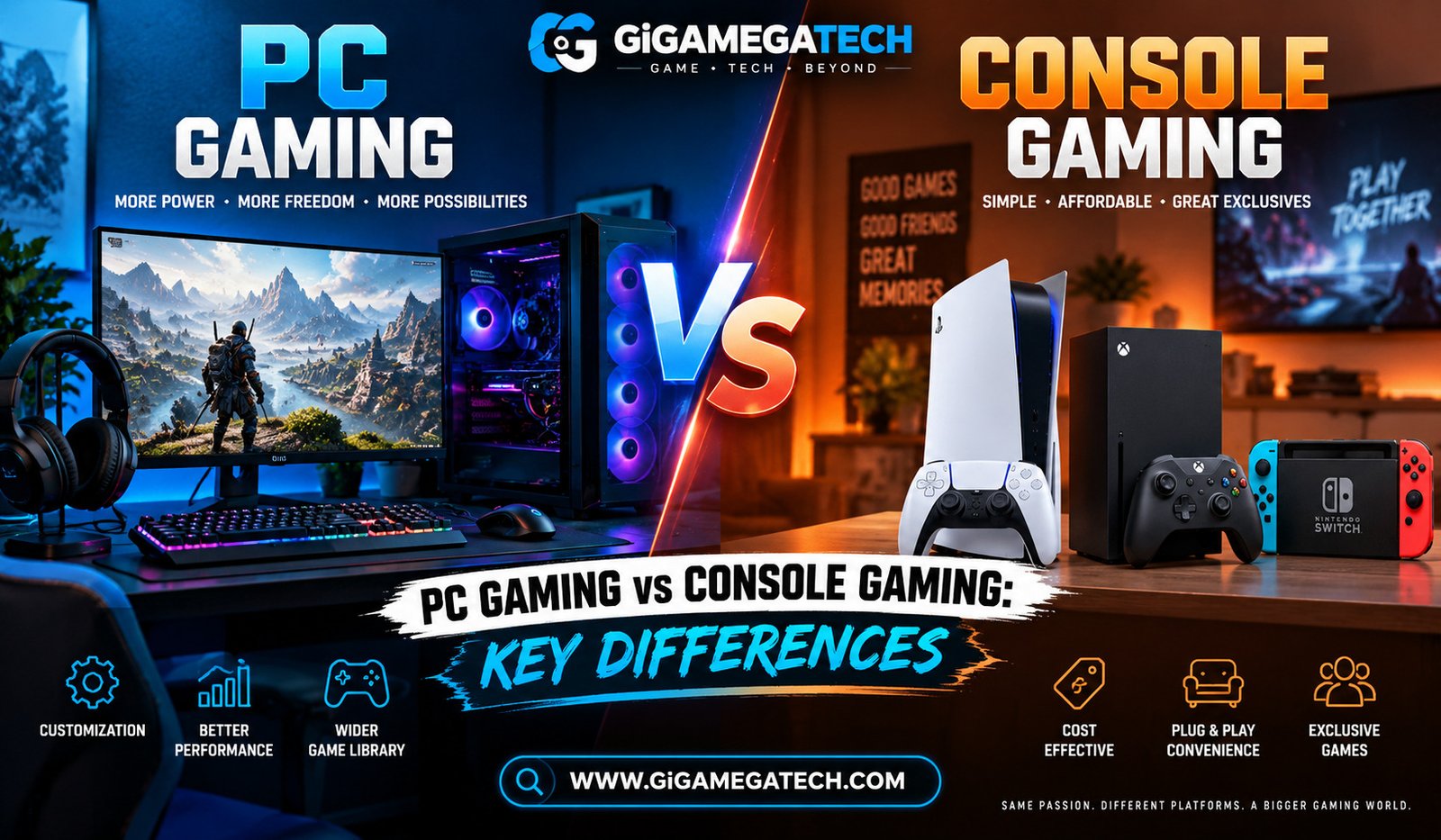
Choosing between a gaming PC and a console is one of the biggest decisions a new gamer faces. Both sides offer strong arguments, and the right choice depends on your budget, habits, and patience for setup. This article breaks down PC gaming vs console gaming across the factors that matter most, so you can decide with confidence rather than guesswork.
Quick Comparison
| Factor | Gaming PC | Console |
| Performance and graphics | Higher frame rates and resolutions, full settings control | Fixed frame rate targets, only a couple of preset modes |
| Upfront cost | Higher once monitor, keyboard, and mouse are included | Lower, ready to play out of the box |
| Game prices | Frequent deep discounts through digital storefronts | Regular sales, though timing and depth vary |
| Online multiplayer cost | Often free | Usually requires a paid subscription |
| Exclusives | Strong in simulation and strategy genres, plus older titles | Some major titles tied to one console brand |
| Backward compatibility | Generally strong, older games run on modern Windows | Varies by generation, some titles need remasters |
| Modding and indie support | Large modding community, strong indie scene | Growing indie support, very limited modding |
| Customization | Choose your own case, cooling, storage, and peripherals | Fixed hardware, limited to storage expansion |
| Repairs | Individual parts can be replaced separately | Often needs a full service center visit |
| Setup and maintenance | May need driver updates and occasional troubleshooting | Largely plug and play |
| Living room experience | Improving with small form factor builds | Built for the TV and couch from the start |
| Learning curve | Rewards those willing to learn settings and hardware | More approachable for new gamers |
| Cross-play | Widely supported in modern titles | Widely supported in modern titles |
Performance and Graphics
A gaming PC can be built or upgraded to run games at higher frame rates and resolutions than most consoles. This flexibility comes at a price, both in cost and in the effort needed to keep hardware current.
Frame Rates and Resolution
- High end PCs can push well beyond 60 frames per second in many titles.
- Consoles typically target a fixed frame rate, often 30 or 60, depending on the game and mode chosen.
- PC players can adjust resolution and settings freely, while console settings are usually locked by the developer.
Graphics Settings Control
On a PC, you can fine tune shadows, textures, and lighting individually. Consoles generally offer a performance mode and a quality mode, giving players only two or three preset options rather than full control.
Cost and Long-Term Value
Upfront price is often the first thing people compare, but the full cost picture includes games, accessories, and future upgrades.
Initial Purchase Price
Consoles usually cost less upfront than a capable gaming PC. A solid PC build that matches current generation consoles in performance tends to cost noticeably more once you add a monitor, keyboard, and mouse.
Game Prices and Subscriptions
- PC games go on sale frequently through digital storefronts, sometimes at steep discounts.
- Consoles also run sales, though timing and depth vary by platform.
- Online multiplayer on consoles often requires a paid subscription, while many PC games let you play online for free.
Long-Term Upgrade Costs
A console generation typically lasts five to seven years without hardware changes. A PC can be upgraded piece by piece, such as swapping only the graphics card, which spreads cost out over time instead of requiring a full replacement.
Game Library and Exclusives
The games you actually want to play often matter more than raw specs.
Platform Exclusives
Some of the most acclaimed titles are tied to a specific console brand and are not available on PC at launch, if at all. Meanwhile, certain simulation and strategy genres are historically stronger on PC due to keyboard and mouse controls.
Backward Compatibility
PC gaming benefits from strong backward compatibility, since older games generally run on modern Windows systems with few issues. Console backward compatibility varies by generation and manufacturer, with some older titles unplayable on newer hardware without remasters.
Indie and Mod Support
PC platforms host a large indie game scene and active modding communities that extend the life of many titles. Consoles have expanded indie support in recent years, though modding remains far more limited due to closed hardware and software.
Customization and Upgradability
This is one of the clearest differences between the two platforms.
Hardware Customization
- PC builders choose their own case, cooling, storage, and components.
- Peripheral choice is wide open, from specialty controllers to mechanical keyboards.
- Consoles offer a fixed hardware package with limited internal customization beyond storage expansion.
Software and Interface Tweaks
PC operating systems allow deep customization of settings, drivers, and background software. Consoles favor a simpler, more locked down interface designed for consistency across every unit sold.
Repair and Part Replacement
Individual PC components can usually be replaced or repaired separately when something fails. Console repairs often require sending the whole unit to a service center or replacing it entirely, depending on the issue.
Convenience and Ease of Use
Not everyone wants to research hardware or troubleshoot drivers, and this is where consoles often win.
Setup and Maintenance
Consoles are largely plug and play, with minimal setup beyond connecting to a TV and the internet. PCs may require driver updates, software troubleshooting, and occasional maintenance to run smoothly.
Living Room Experience
Consoles are built for the living room, connecting easily to a television and working comfortably from a couch with a controller. PC setups traditionally favor a desk, though small form factor builds and streaming devices have narrowed this gap.
Learning Curve
New gamers often find consoles more approachable, since there is less to configure before playing. PC gaming rewards players willing to learn about settings and hardware, but that same depth can feel overwhelming to beginners.
Online Experience and Social Features
Multiplayer gaming looks a little different depending on which platform you choose.
Matchmaking and Cross-Play
Many modern titles support cross-play between PC and consoles, narrowing this gap significantly compared to previous generations. Matchmaking pools tend to be larger when cross-play is enabled, which can mean shorter wait times.
Communication Tools
Console platforms include built in party chat and messaging systems designed for quick setup. PC gamers often rely on third party voice chat apps alongside in-game options, offering more features but requiring extra setup.
Achievements and Social Profiles
Both platforms track achievements and trophies tied to a player profile. PC storefronts and console ecosystems each have their own systems, so progress and friend lists generally do not transfer between them.
Key Takeaways
- Performance favors PC: Higher frame rates and deeper graphics control are easier to achieve on PC.
- Consoles cost less upfront: A comparable PC build usually costs more once accessories are included.
- Exclusives shape the decision: Some major titles remain tied to one platform.
- Customization favors PC: Hardware, peripherals, and software settings are far more flexible.
- Consoles win on convenience: Setup and daily use require less technical knowledge.
- Cross-play is closing the gap: Many games now let PC and console players compete together.
FAQs
Is PC gaming more expensive than console gaming overall?
Yes, a PC that matches console performance generally costs more once games, accessories, and upgrades are included.
Can PC and console players play together online?
Many modern games support cross-play, though it depends on the specific title and platform.
Do consoles ever get game discounts like PC platforms?
Yes, consoles run regular sales, though the frequency and depth of discounts can differ from PC storefronts.
Is console gaming easier to set up than PC gaming?
Yes, consoles are largely plug and play, while PCs may need driver updates and additional configuration.
Does modding work on consoles the same way it does on PC?
No, modding is far more limited on consoles due to closed hardware and software restrictions.
Conclusion
The choice between PC gaming vs console gaming comes down to what you value most as a player. PC gaming offers stronger performance, deeper customization, and a wider library through mods and older titles, but it asks more of your time and budget. Console gaming trades some of that flexibility for simplicity, a lower starting cost, and a smoother living room experience. Neither option is objectively better, and many gamers end up choosing based on which trade-offs fit their lifestyle best.